
A month-long national lockdown to arrest the spread of COVID 2.0 could shave off 100-200 bps of GDP, leading to a 300 bps risk to annual growth, a brokerage report has flagged while expressing doubts over the ability of local lockdowns to control the pandemic. The second wave of the coronavirus inflection has caught the government off-guard with the daily cases jumping over 6.5 times in the past 30 days. With close to 3.53 lakh fresh daily infections, the country is the worst hit globally.
However, dollar's rise against other currencies overseas capped the gains

The Reserve Bank will go for a "dovish pause" at Wednesday's policy review announcement amid developments such as a rise in inflation, government maintaining the inflation target band and a likely impact on growth due to local lockdowns on rising COVID-19 infections, analysts said on Monday. Economists at American brokerage Bofa Securities said price stability, growth and financial stability will become the prime focus areas for the central bank going forward. "The RBI MPC (Monetary Policy Committee) should deliver another dovish pause on Wednesday," it said. The policy announcement, the first for the fiscal, will come days after the government maintained the RBI's target to ensure inflation to be within 2-6 per cent band for five more years.

India's exports are unlikely to get an immediate boost from a depreciating rupee, which touched an all-time low on Monday, driven by rising commodity prices. The rupee fell to 76.97 against the dollar earlier in the day, settling 1.05 per cent weaker than the previous close. Oil prices soared to their highest since 2008 on Monday at $139 per barrel, after the US and European allies explored a Russian oil import ban, while delays in the potential return of Iranian crude oil to global markets increased supply fears.

India Ratings on Mondy projected a 7.7 per cent growth this fiscal driven by consumption demand.
.jpg)
It also painted a grim possibility of any major gains in the rupee during the current fiscal saying that the continuing global volatility, and domestic political uncertainty ahead of the 2014 hustings will limit chances of any significant appreciation apart from further impact growth.

'This is a good time to restructure your portfolio because the sectors and stocks that performed in the last bull market may not perform as much now.'

ONGC was the top loser in the Sensex pack, shedding around 3 per cent, followed by IndusInd Bank, PowerGrid, Axis Bank, HCL Tech, NTPC and ITC. On the other hand, UltraTech Cement, TCS, Tata Steel, Titan and HDFC were among the gainers.

Bank of America Merrill Lynch believes this would ease pressures on CAD as $10 a bbl fall in oil price reduces CAD by $8 billion or 0.4 per cent of GDP.

'Hope they don't tinker around with capital gains tax in any way.'

'It was because of the huge selloff in the Indian equities that the rupee fell so sharply against the dollar on Friday.'

There was sustained selling of the American currency by exporters ahead of a decision of US Federal Reserve on tapering its monetary stimulus.

The rupee continued to rule firm against the dollar for the second consecutive day.
Hawkish guidance by the US Fed raises concerns it could tie the hands of RBI from trimming rates.

Rupee is seen to remain in the range of 67.50-68.80 in the short-term
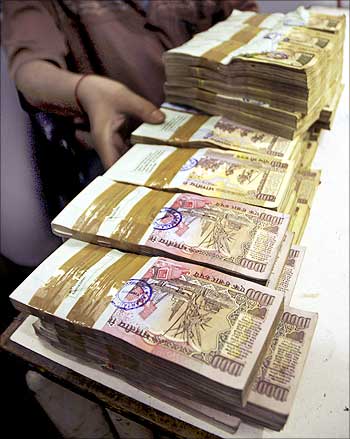
The local currency had gained 7 paise to close at 66.57 in Monday's trade.

A weaker rupee could aid corporate earnings through its positive impact on export intensive sectors such as information technology services, pharmaceuticals and commodity producers such as metal and mining, and oil and gas companies.

The rupee recovered by 15 paise at 65.49 against the US dollar.

Delivering a public speech hours after the RBI launched a rescue act for Yes Bank on March 6, Governor Shaktikanta Das reiterated the RBI's affirmation to do whatever was needed to combat the coronavirus impact. On that day, India had only one confirmed COVID-19 infection, the World Health Organisation was five days off from declaring it as a pandemic and the financially debilitating lockdowns were not even on the horizon. Das' promise on efforts to mitigate COVID-19 impact appeared as a footnote in news reports from the event.
A weak dollar against major world currencies supported the domestic unit.

Managing Brexit, inflation and banking reforms, along with the political environment, will be tough.

Research and ratings agencies like Icra and Moody's have said the CAD in 2018-19 would be much higher than 2017-18

The recent market crash in China has triggered sympathetic drops.

Forex dealers said besides dollar's gains against other currencies, fresh demand for the American unit from importers and a weak opening in the domestic equity market put pressure on the rupee.

In the forward market, the premium for dollar moved up on fresh paying pressure corporates.

The finance ministry on Tuesday cited "green shoots" of recovery in agriculture, manufacturing and services sectors, and said the prompt policy measures taken by the government and RBI have helped reinvigorate the economy with minimal damage. Stating that the agricultural sector remains the foundation of the Indian economy, the ministry said that a normal monsoon, as has been forecast, should support the rebooting of economy.

We should not see a strong rupee as strength but target a fairly priced rupee for restoring our competitiveness, says Rashesh Shah.
.jpg)
The minister also promised more policy decisions in the coming days saying 'reforms is a work in progress'.
The rupee on Thursday hit an all-time low of 59.93 intra-day, before the Reserve Bank stepped in to help the local currency recover some ground.

It makes sense to wait for govt schemes such as gold bonds.

The local currency lost some of the gains after the forex market realised that RBI's decision would result in only up to $3 billion extra dollar supply in the market in initial stages.

RBI might not cut rate on June 2 but will surely cut soon.

Since its peak, the S&P BSE Sensex has dropped nearly 3,000 points.

FPIs, which are holding large exposures in Indian debt, could also be expected to book some capital gains as yields slide down
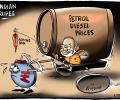
One of the major advantages of buying Iran crude is the additional credit period of 90 days that the country gives to India, compared to 30 days by other countries.
Rupee hits 2-month low, down 21 paise against dollar.

Shaktikanta Das said in Washington, DC, that there was nothing sacrosanct about the 25 bps rate cut and that monetary policy could be well served by calibrating the size of the policy rate to the dynamics of the situation, and the size of the change itself could convey the stance of policy.

Overall forex market sentiment suffered a sudden reversal of fortune contrary to expectation largely moving in line with local equities, reversing all early strong gains.

Corporates' forex borrowings have grown at a CAGR of 15.6% since 2008.

The dollar index, which tracks the world's reserve currency against a basket of its peers, is down 0.16 per cent at 97.58.
 © 2026 Rediff.com - Investor Information - Advertise with us - Disclaimer - Privacy Policy - Sitemap - Feedback - About us - Terms of use - Grievances